
Executive Summary
Artificial Intelligence (AI) didn’t arrive overnight. It’s the product of nearly a century of progress — a story of theory, experimentation, failure, and eventual transformation.
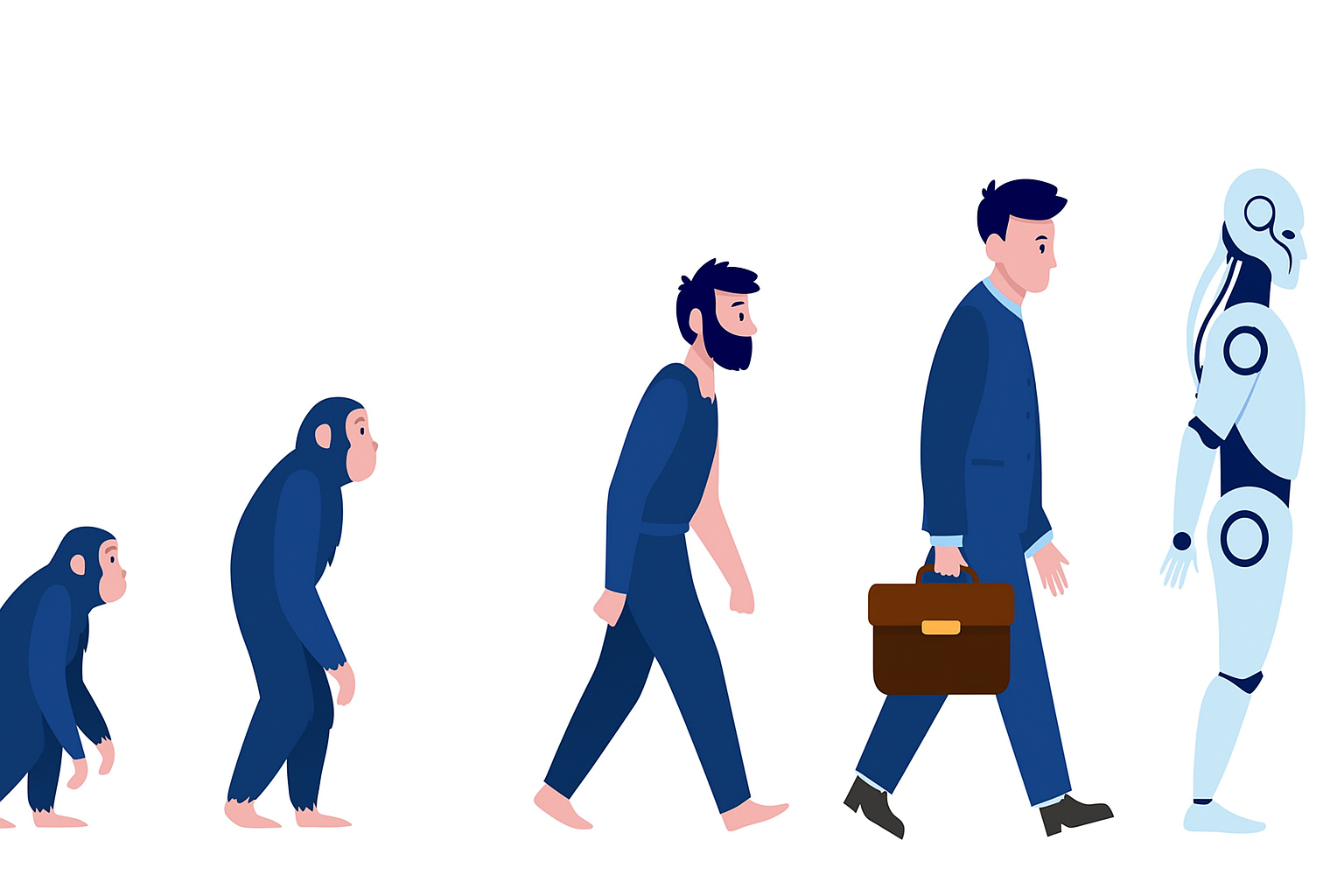
From early mechanical reasoning to neural networks and modern generative AI, the evolution of AI mirrors our quest to replicate — and now extend — human intelligence.
This whitepaper traces the key milestones in AI’s development, the cycles of optimism and disillusionment that shaped it, and how today’s breakthroughs in machine learning and generative systems mark the beginning of a new technological era.
1. The Origins: 1940s–1950s – The Birth of the Idea
The concept of machines that “think” predates computers.
Philosophers like Alan Turing and John von Neumann proposed that logic and computation could replicate human reasoning.
Key moments:
- 1936: Alan Turing defines the “Turing Machine” — a mathematical model for computation.
- 1943: Warren McCulloch and Walter Pitts propose the first artificial neuron model.
- 1950: Turing publishes “Computing Machinery and Intelligence”, introducing the Turing Test — the idea that machine intelligence could be judged by human indistinguishability.
- 1956: The Dartmouth Conference, led by John McCarthy, Marvin Minsky, and Claude Shannon, coins the term Artificial Intelligence.
These pioneers believed general machine intelligence was achievable within a generation. They were only off by a few decades.
2. The First Wave: 1960s–1970s – Symbolic AI
The first AI systems relied on symbolic reasoning — encoding human knowledge as explicit rules and logic statements.
Notable systems:
- ELIZA (1966): A natural language program that mimicked a psychotherapist.
- SHRDLU (1970): Understood and manipulated objects in a virtual world using language.
- Expert Systems (1975–1985): Used rule-based logic for medical, legal, and technical diagnostics (e.g., MYCIN for disease diagnosis).
Challenge: Symbolic AI could reason about structured knowledge but couldn’t learn or adapt. Real-world problems proved too messy for rigid rule sets.
3. The AI Winter: 1974–1980
Ambitious promises outpaced results. Funding dried up as projects failed to scale beyond prototypes.
The first AI Winter hit — a period of skepticism and budget cuts.
Computers were slow, data was scarce, and researchers lacked the tools for self-learning systems.
AI retreated into academia, awaiting better algorithms and faster machines.
4. The Second Wave: 1980s–1990s – Expert Systems and Early Neural Nets
AI regained momentum as hardware improved.
Corporations invested in expert systems, which encoded specialist knowledge into decision trees.
At the same time, neural networks quietly reemerged:
- 1986: The backpropagation algorithm was rediscovered, enabling multilayer neural networks to learn from data.
- 1997: IBM’s Deep Blue defeated world chess champion Garry Kasparov — a landmark in applied machine reasoning.
Still, these systems were narrow — good at defined tasks but far from general intelligence.
5. The Data Era: 2000s – Machine Learning Comes of Age
As the internet exploded, so did data. AI shifted from programming rules to training algorithms.
Key innovations included:
- Support Vector Machines (SVMs) for classification.
- Bayesian networks for probabilistic reasoning.
- Speech and image recognition breakthroughs via massive datasets.
- 2006: Geoffrey Hinton coins the term “Deep Learning”, introducing multi-layered neural networks for feature extraction.
AI began to show human-level performance in pattern recognition, setting the stage for the deep learning revolution.
6. The Deep Learning Revolution: 2010s
Deep learning transformed AI from theory to reality.
Two factors made this possible: big data and powerful GPUs.
Milestones:
- 2012: AlexNet wins the ImageNet competition, cutting image classification errors by half.
- 2016: Google’s AlphaGo defeats a world champion in Go, demonstrating strategic learning and intuition-like reasoning.
- 2018: Transformer architecture (introduced by Google) revolutionizes language processing — forming the basis for GPT, Claude, Gemini, and modern generative models.
Deep learning shifted the paradigm: machines no longer followed rules — they learned patterns from vast datasets.
7. The Generative Era: 2020s–Present
The past few years have ushered in the generative AI explosion — systems capable of producing human-like text, images, code, music, and even video.
Key developments:
- 2020: GPT-3 showcases large language models (LLMs) as powerful general-purpose tools.
- 2022: DALL·E 2 and Midjourney bring generative art to the public.
- 2023–2024: OpenAI GPT-4, Anthropic Claude, Google Gemini, and Mistral redefine multimodal intelligence.
Generative AI doesn’t just analyze information — it creates it.
Businesses now use these models to automate content, accelerate software development, and augment decision-making at scale.
8. The Road Ahead: Toward Artificial General Intelligence (AGI)
AI is transitioning from narrow specialization to agentic autonomy — where systems can reason, plan, and act independently.
Emerging technologies such as agent-based AI, neurosymbolic learning, and self-improving models are early steps toward true general intelligence.
However, challenges remain:
- Data bias and hallucinations
- Energy consumption
- Ethical and regulatory oversight
- Alignment of machine objectives with human values
The next era of AI will be defined not only by capability — but by responsibility.
9. Conclusion
The history of AI is the story of human persistence — of bold ideas, repeated setbacks, and exponential breakthroughs.
From Turing’s theoretical machine to today’s generative models, AI has evolved from a curiosity into a core pillar of modern business, science, and creativity.
The lesson is clear: AI progress doesn’t happen in leaps — it happens in layers.
And each layer builds on a simple truth first imagined nearly a century ago: that intelligence, human or artificial, begins with learning.
Leave a Reply